
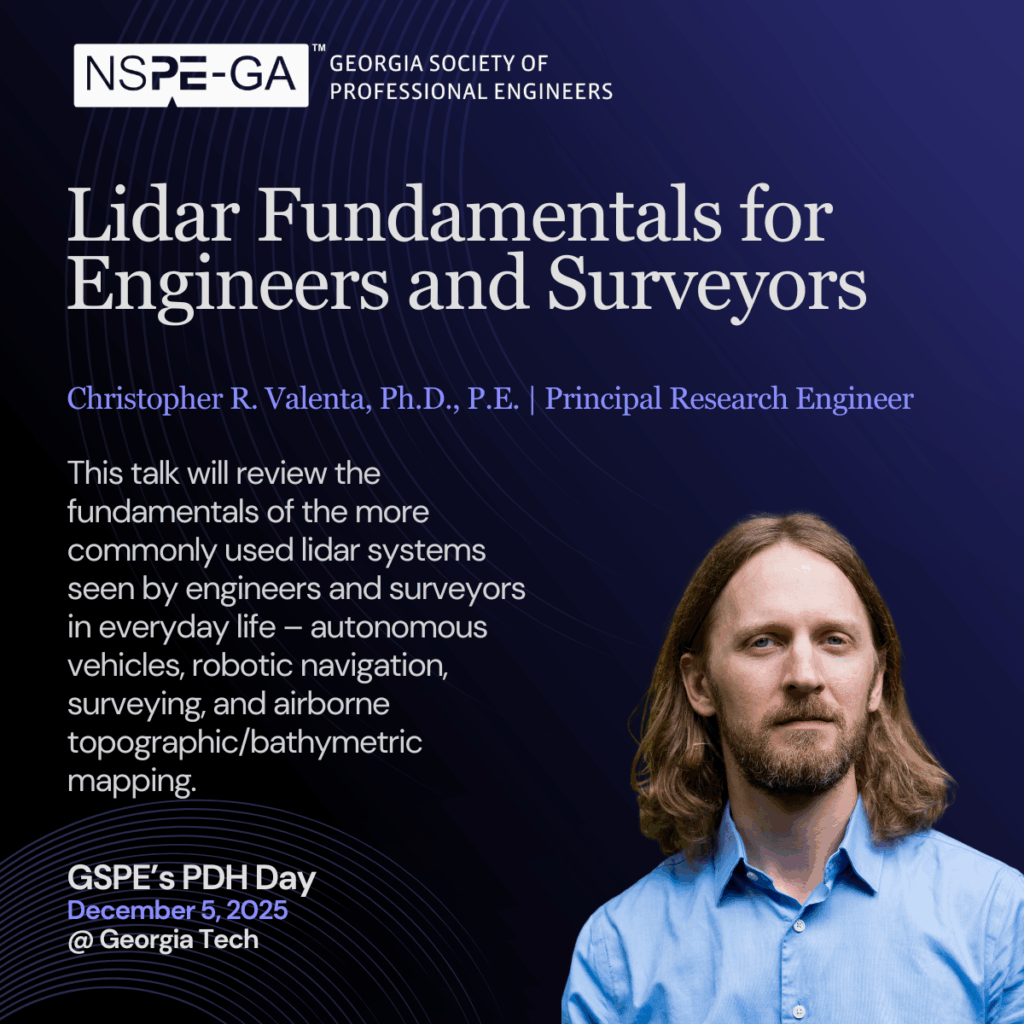
Light Detection And Ranging (lidar) systems are a versatile remote sensing technique that has gained popularity due to the push for fully autonomous vehicles and robotic applications. An active sensing system which operates in the optical part of the electromagnetic spectrum, lidar offers complementary situational awareness to the more commonly recognized radar and camera/vision systems. Compared to radar, lidar uses shorter wavelengths which allow for higher resolutions and unique sensing approaches, but has tradeoffs in terms of cost and certain sensitivities. Despite the recent utilization by the automotive industry, lidar has existed since around the invention of the laser in 1960 and been implemented for a remarkably diverse set of applications – satellite laser ranging, spacecraft navigation, nautical mapping, wind sensing, atmospheric temperature sensing, video and film production, and more! The choice of laser wavelength (frequency), scan mechanism and pattern, coherent versus incoherent detection, and pulsed or continuous wave excitation, among others, give system designers a myriad of options to sense the world around us. Fundamentally, understanding how light interacts with the atmosphere and different materials and devices is critical to exploiting this unique sensing technique. This talk will review the fundamentals of the more commonly used lidar systems seen by professional engineers and surveyors in every day life – autonomous vehicles, robotic navigation, surveying, and airborne topographic/bathymetric mapping.
PDH Day registration is open. Learn more at https://gspe.org/pdh-day/
About Chris
Christopher R. Valenta, Ph.D., P.E. is a Principal Research Engineer and associate division head at the Georgia Tech Research Institute (GTRI) Electro-Optical Systems Laboratory (EOSL) as well as an Adjunct Professor in the School of Electrical and Computer Engineering at Georgia Tech. He has built and researched a variety of lidar systems including airborne topography and bathymetric, automotive, and a number of atmospheric lidar systems including aerosol, 3D wind, temperature, water vapor, and ozone, among others. Dr. Valenta’s work has been documented in over 100 publications and been featured in Space News, Aviation Week, Wired, US News and World Report, and RFID Journal, among others. Dr. Valenta is a Senior Member of the IEEE and SPIE, member of OSA, and DEPS and serves in numerous professional leadership positions. Dr. Valenta is the winner of the 2015 IEEE Microwave Magazine Best Paper Award, a Georgia Tech 40 Under 40 winner, a 2020 SPIE Rising Researcher, and a registered professional engineer in the state of Georgia.